How to Run a 100% Cashless Event Without a Single Payment Failure
There is a specific kind of silence that happens at a festival when the internet goes down. It’s not the peaceful kind. It’s the sound of thousands of people standing in queues, staring at spinning loading icons on payment terminals, while vendors look increasingly panicked and the "cashless" dream turns into a logistical nightmare.
Going 100% cashless is the gold standard for modern events. It’s faster, it’s more secure, and it provides a goldmine of data for organisers. But it also introduces a single point of failure: the network. If your connection drops, your revenue stops. Period.
At Commsuk Limited, we’ve seen it all: from small pop-up markets to massive greenfield festivals. We know that "standard" internet doesn't cut it when you have 10,000 people trying to upload Instagram stories while your bar staff are trying to process a round of drinks.
Here is exactly how you run a cashless event that never fails.
Why Your 4G Router Is Lying to You
Most event planners start with a simple idea: "We’ll just use a bunch of 4G dongles or a beefy mobile router."
On paper, it makes sense. You look at your phone, see four bars of 5G, and think you're golden. But there is a massive difference between bandwidth and congestion.
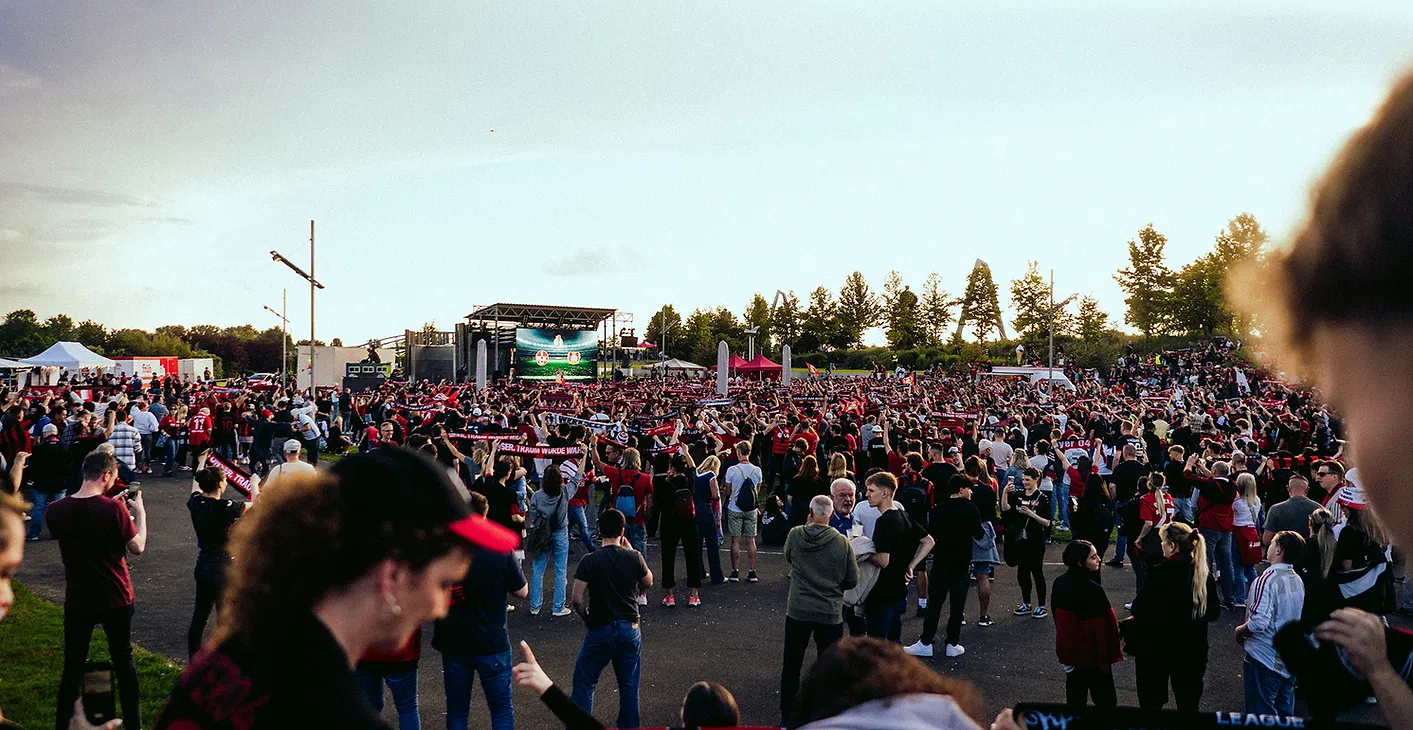
When a field is empty, a 4G tower in the distance can easily handle a few hundred Mbps. But when that field fills up with 20,000 attendees, every single one of those phones is fighting for a "handshake" with that same tower. This creates "signalling overload." Even if your router shows a strong signal, the packets of data for your payment terminals are getting stuck in the digital equivalent of a massive traffic jam.
Payment terminals are particularly sensitive. They don't need much data, but they need it instantly. If the "handshake" with the bank takes more than a few seconds, the transaction times out. This is why 4G fails at events: it's not that there isn't enough internet; it's that there are too many people trying to use it.
The Commsuk Strategy: Managed Connectivity
To run a fail-safe cashless system, you need to stop thinking about "getting internet" and start thinking about "managing a network." At Commsuk, we provide fully managed connectivity solutions that bypass the public congestion entirely.
1. Satellite Uplinks (The High Ground)
We don't rely on the local phone mast. We bring our own sky. By using high-performance satellite dishes, we create a dedicated pipe of data that doesn't care how many people are using their phones nearby. This is "clean" bandwidth, reserved solely for your event's critical operations: like payments, ticketing, and production.
2. Dedicated Payment VLANs
We don't mix your payment traffic with the guest Wi-Fi. We set up a "Virtual Local Area Network" (VLAN) specifically for your Point of Sale (POS) terminals. This means that even if a guest finds a way to start downloading a 4K movie on the public Wi-Fi, it won't affect the speed of your bar transactions by a single millisecond.
3. Professional Deployment
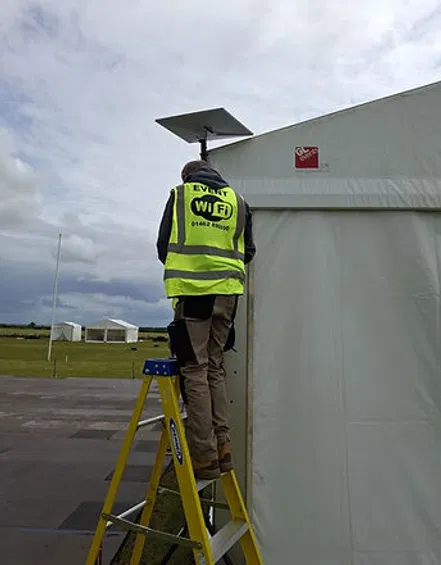
Installing a network in a field is different from installing it in an office. You need to account for line-of-sight, weatherproofing, and physical security. Our technicians are on-site before the gates open, installing satellite dishes on marquees and running secure cables to every vendor booth.
Redundancy Is Not Optional
If you are running a 100% cashless event, your connectivity needs a "Plan B" (and usually a Plan C). In the networking world, we call this redundancy.
We never rely on a single source of internet. A typical Commsuk setup includes:
Primary: High-speed Satellite (Starlink Business or similar).
Secondary: A high-gain multi-carrier 4G/5G array that bonds different networks together.
Tertiary: Hard-wired connections where possible.
Our routers are "failover-ready." This means if a satellite link is momentarily interrupted (say, by an extreme weather event), the system automatically switches to the cellular backup so fast that the payment terminal doesn't even notice. The transaction goes through, the customer gets their drink, and the queue keeps moving.
The Secret Sauce: Local Caching and Offline-First
To be truly 100% fail-proof, your payment system should be "offline-first." This is a technical approach where the payment terminal is smart enough to handle the transaction locally and "sync" with the cloud whenever the connection is available.
At large-scale festivals, we often recommend closed-loop RFID systems. Attendees load money onto a wristband at a top-up station, and then tap their wristband at every vendor.
Why is this better? Because the "balance" is stored on the wristband and the local server. The terminal doesn't need to talk to a bank in London for every single £6 pint. It just talks to our on-site local server. This "local caching" eliminates the latency of the public internet entirely. Even if a meteor took out every satellite in orbit, your attendees could still buy a burger because the local network is still talking to itself.
Rural and Greenfield Challenges
Agricultural shows and rural festivals face the hardest connectivity hurdles. Often, these locations have zero fibre infrastructure and terrible mobile coverage.
We specialise in these "impossible" locations. Whether it’s a John Deere tractor dealership in a remote field or a boutique festival in a valley, we bring the same level of reliability. We perform comprehensive site surveys months in advance to map out exactly where the dead zones are and where our "mesh" of Wi-Fi access points needs to be placed to ensure 100% coverage across the entire site.

Hands-On Monitoring
The biggest mistake event organisers make is "setting and forgetting." They hire a company to drop off some routers and then wonder why things fail at 9 PM on Saturday night when the crowd is at its peak.
Commsuk provides continuous on-site monitoring. We have engineers in a "Nerve Centre" on-site who are watching the traffic in real-time. If we see a particular vendor's terminal struggling, we can boost the signal to that area or swap out hardware before it becomes a problem.
We handle the teardown, too. You have enough to worry about when the event ends; the last thing you want to do is pack up sensitive networking equipment and untangle 500 metres of ethernet cable.
Summary Checklist for a Failure-Free Cashless Event
Stop relying on public 4G/5G: It will fail when the crowd arrives.
Use Satellite as your primary uplink: It bypasses local tower congestion.
Demand a dedicated VLAN: Keep payment traffic away from guest and staff Wi-Fi.
Hardware Failover: Ensure your router can switch between satellite and cellular automatically.
Local Caching: Use payment systems that can operate on a local server or "offline" mode.
On-Site Support: Have technicians who know the site and can react instantly.
Running a cashless event shouldn't feel like a gamble. When the connectivity is rock-solid, the tech disappears into the background, and you can focus on what actually matters: running a great show.
Ready to bulletproof your next event's connectivity? Get in touch with the Commsuk team for a site survey and a tailored quote. We’ll make sure the only thing your attendees have to wait for is the encore.
Comments