Does 'Full Signal' Really Matter in 2026? The Truth About Event Network Capacity
We’ve all been there. You’re at a major festival, a high-stakes corporate conference, or a packed trade show. You look down at your phone, see five solid bars of signal, and try to post a quick update or check a message.
Nothing happens. The loading wheel spins. The "Message Failed" notification pops up.
It’s one of the most common frustrations in the event industry, even here in 2026. As Managing Director at Commsuk Limited, I see this misconception every single day: the idea that "full bars" equals a working network. In reality, signal strength is only half the story: and in a world where every attendee is carrying three or four connected devices, it might actually be the less important half.
The truth is that in 2026, signal is a commodity, but capacity is a luxury. Let’s break down why those bars on your phone are lying to you and what actually matters when you’re trying to keep thousands of people connected.
The "Full Bars" Illusion
Think of signal strength like the volume of a radio. If someone is shouting at you from across the room, you can hear them perfectly clearly (that’s your "full bars"). However, if a thousand other people are also shouting in that same room at the same volume, you won’t be able to understand a single word.
That is the difference between signal and capacity.
Signal strength (RSSI) is simply a measure of how loud the Access Point (AP) or the cell tower is. It tells your phone that the connection is physically close and the "noise" is low enough to establish a link. But it says absolutely nothing about how much data can actually travel through that link at any given moment.
At Commsuk Limited, we’ve moved past the era of just "providing signal." We focus on the plumbing: the actual pipe that carries the data.
Why 2026 Changed the Game
If we were back in 2016, a few "full bars" might have been enough to get by. People were just checking emails and posting low-res photos. Fast forward to 2026, and the landscape is unrecognizable.
Today, every attendee isn't just a "user." They are a data-hungry node. They have a smartphone, a smartwatch, perhaps a pair of AR glasses, and a tablet in their bag. On top of that, your event infrastructure: the POS systems, the digital signage, the live-stream cameras: is all competing for the same airwaves.
When you have 5,000 people in a hall, you don't just have 5,000 connections; you likely have closer to 15,000 to 20,000 active sessions. This is where "signal" fails and "capacity" becomes the only metric that matters.
Capacity vs. Bandwidth: The Motorway Analogy
To understand why your event WiFi might be crawling despite a perfect signal, think of a motorway.
Signal Strength is the speed limit. If it’s high, you could go fast.
Bandwidth is the width of the road.
Capacity is the ability of the road to handle 10,000 cars at once without a traffic jam.
You can have a 10-lane motorway (huge bandwidth) with a 70mph speed limit (great signal), but if 50,000 cars try to merge onto it at the same time, everyone is going to be sitting at a standstill.
In the event world, we solve this by creating more "lanes" and managing the traffic intelligently. We don't just put up one big "loud" antenna. We deploy high-density arrays that talk to smaller groups of people, ensuring that the total capacity of the venue is distributed fairly.
Designing for Density, Not Distance
Many event organizers make the mistake of asking, "How far does this WiFi reach?"
At Commsuk, we ask, "How many people can we fit into this square meter?"
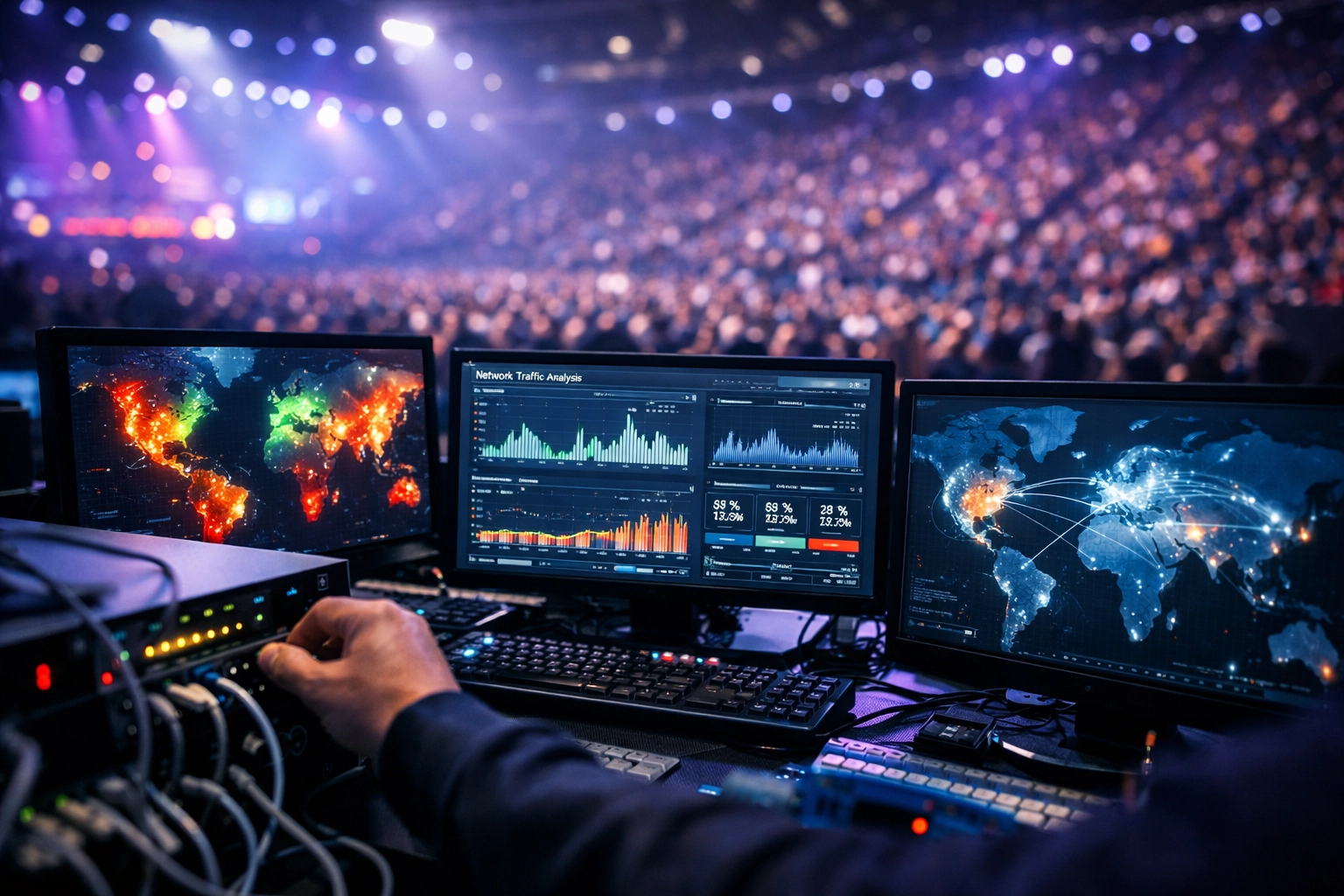
In 2026, high-density networking is an art form. It requires sophisticated frequency planning. If you turn up the power on your Access Points too high to get those "full bars" across the whole venue, the APs will actually start interfering with each other. This is called "co-channel interference," and it’s the quickest way to kill an event network.
Our engineers focus on "small cell" architecture. By limiting the range of each AP but increasing the number of units, we can handle significantly more data. It’s a more complex setup, but it’s the only way to guarantee that when an attendee wants to live-stream a keynote in 4K, they actually can.
The Backhaul Factor: Where Does the Internet Come From?
Even the best internal WiFi network is useless if the "backhaul": the connection from the venue to the wider internet: is weak.
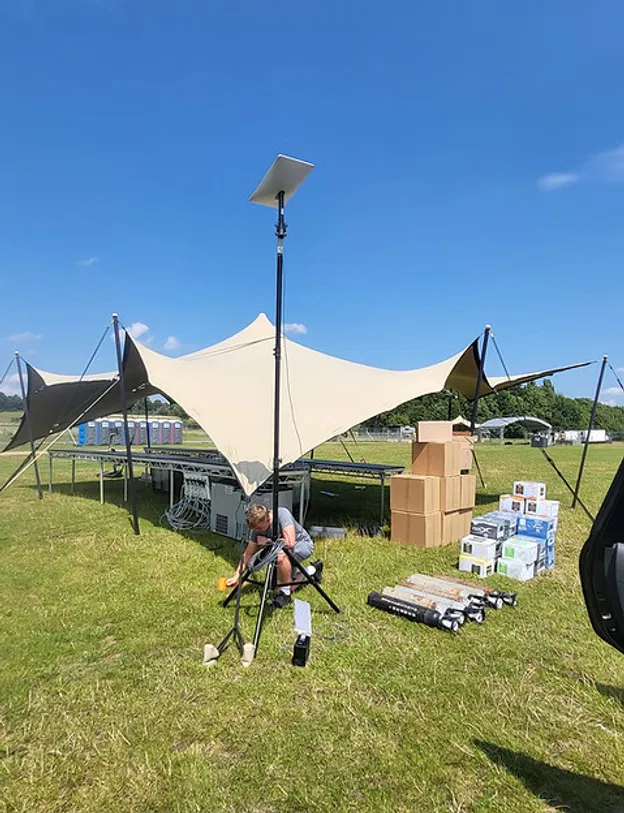
In remote locations or busy urban centers where local exchanges are congested, we often rely on hybrid solutions. We’ve seen a massive shift toward satellite integration. In fact, industry data shows that over 90% of telecom leaders now view satellite as a core part of their strategy.
Whether we are using a dedicated fiber line or a high-performance satellite uplink, our goal is to ensure the "pipe" leading out of the event is just as wide as the network inside. This is a core part of our event services. We don't just give you a router; we bring the entire infrastructure needed to make that router work.
What Event Organisers Should Really Be Asking
If you’re planning an event in 2026, stop asking your tech providers if there will be "full signal." Instead, try asking these three questions:
"What is the concurrent user capacity of the system?" (How many people can actually use it at the same time?)
"How are you managing frequency interference in high-density areas?" (How do you stop the WiFi from tripping over itself?)
"What is the guaranteed throughput per user during peak times?" (If everyone clicks 'upload' at once, what happens?)
These questions get to the heart of the matter. They move the conversation away from "bars" and toward "performance."
The Commsuk Reassurance
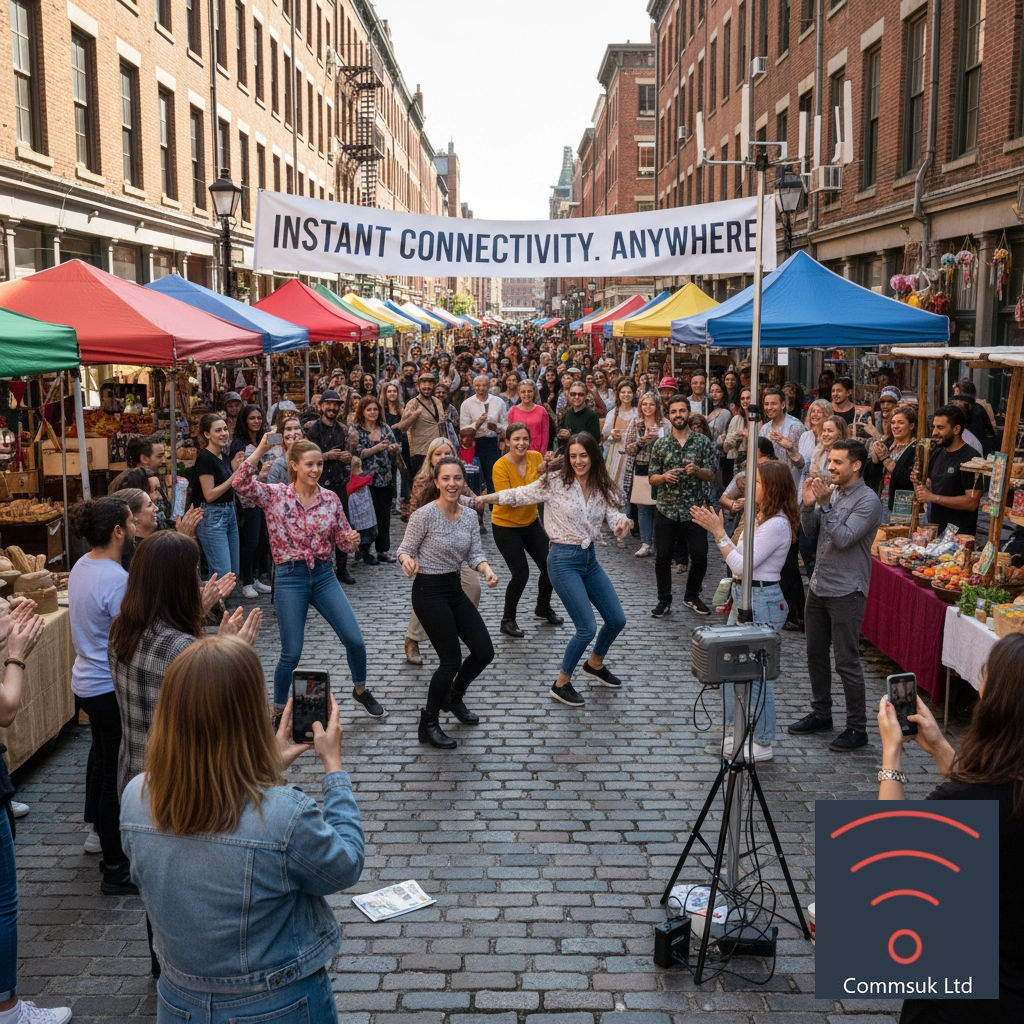
At Commsuk Limited, we understand that for a modern event, the internet is as essential as electricity or water. If the WiFi fails, the event fails. Attendees can’t share, vendors can’t take payments, and organizers lose their real-time data.
We specialize in the "impossible" locations: the middle of a field, a historic building with thick stone walls, or a high-density urban rooftop. We don't just look for "full bars." We build resilient, high-capacity environments that stay stable under pressure.
Whether you are looking at our plans and pricing or just starting to plan your connectivity, our approach is always the same: minimalist, professional, and entirely focused on results.
Final Thoughts
In 2026, we should be past the point of being impressed by a phone screen showing "5G" or "WiFi 7" with full bars. We’ve all seen those symbols fail us too many times.
The next time you’re planning an event, ignore the signal bars for a moment and look at the capacity. Look at the infrastructure. Look at the team behind the screens.
Reliability isn't about how loud the signal is; it's about how smart the network is.
If you want to ensure your next event has the capacity to handle the modern world, get in touch with us. We’ll make sure your attendees aren't just seeing full bars: they’re actually getting the connection they expect.
By James Lunnon Managing Director, Commsuk Limited
Comments