Sleep Soundly: How We Lock Down Your Event WiFi Security
You’ve got a thousand things on your mind. The catering is running five minutes late, the keynote speaker is pacing backstage, and the branding on the main stage is slightly off-centre. The last thing you want to worry about is whether a hacker in a hoodie is sitting in the back row snooping on your attendees’ private data.
In 2026, data security isn't just a "nice to have": it’s the backbone of a successful event. A single breach can ruin a reputation faster than a bad sound system. But here’s the good news: at Commsuk Limited, we believe you should be able to sleep soundly. We take the "heavy lifting" of network security off your plate, so you can focus on running the show.
Let’s break down how we lock things down, in plain English.
The Digital "Bouncer": Why Event Security Matters
When you open a WiFi network to hundreds or thousands of people, you’re essentially inviting them into a shared digital space. Without the right protections, it’s like hosting a party where every guest can look through everyone else's pockets.
Standard home WiFi isn't built for this. Even many "professional" setups leave gaps wide enough for a truck to drive through. We see it all the time: open networks with no encryption, or "guest" networks that actually let users see the event’s internal credit card machines. This is where payment failures at events often start: not just from bad signal, but from compromised security.
1. Network Isolation: Putting Walls Between Guests
Imagine your event is a giant hotel. In a poorly secured network, every guest has a key that fits every door. In a Commsuk-managed network, everyone has their own private room.
We use something called Client Isolation. This is a simple but powerful setting that prevents one device on the WiFi from "talking" to or even seeing another device. If an attendee is using an iPhone 12 Pro to check their emails, the person sitting next to them shouldn't be able to find that phone on the network.
By keeping every connection in its own "silo," we stop the spread of malware and prevent "man-in-the-middle" attacks where hackers try to intercept data between a device and the internet.

2. WPA3: The Gold Standard of Encryption
You’ve probably seen "WPA2" on your router at home. It’s been the standard for years. But for high-stakes events in 2026, we’ve moved up to WPA3.
Think of WPA3 as a much more complex "secret code" for the data travelling through the air. It provides much stronger protection against "brute force" attacks (where a computer tries millions of passwords a second to get in). Even if your event WiFi password is "Coffee2026," WPA3 makes it incredibly difficult for anyone to crack the encryption.
We ensure that even on our Starlink-backed remote setups, the encryption standards are top-tier. Whether you're in central London or the middle of a field, your data is wrapped in a digital armoured vest.
3. Dedicated Lanes for Different Users
Not all WiFi traffic is created equal. Your exhibitors need to process sales, your production team needs to run the live stream, and your attendees want to post on Instagram. If they’re all on the same "lane," things get slow: and risky.
We use Network Segmentation. We create virtual "lanes" that are completely separated from each other:
The Production Lane: Locked down, hidden, and ultra-secure for your staff and scanners.
The Exhibitor Lane: Reliable and fast for dedicated booth WiFi.
The Guest Lane: Easy to access but strictly isolated from the "business" side of the event.
This way, even if a guest's device is compromised, there is zero path for that virus to jump over to your ticket-scanning system or your VIP’s private laptop.

4. Firewalls and "Smart" Monitoring
A firewall is like a digital gatekeeper that decides who gets in and who gets out. But we don’t just set it and forget it. Our systems use Intrusion Prevention Systems (IPS).
These are "smart" filters that look for weird patterns. If a device on the network starts acting like it’s trying to scan other computers or send out a million spam emails, our system spots it instantly. It doesn't just flag it; it can automatically kick that device off the network before it causes any trouble.
This is especially important when you’re using AI-driven apps for your event. These apps require a stable and secure connection to function correctly. By keeping the "junk" traffic out, we ensure the "smart" tech has plenty of room to work.
5. Physical Security: The "Out of Sight" Protection
Security isn't just about code; it’s about hardware. We don't just leave expensive routers sitting on a table for anyone to plug a cable into.
When our engineers are on-site, they ensure that the "guts" of the network: the switches, the satellite uplinks, and the controllers: are tucked away in secure cases or mounted high out of reach. We’ve seen events where a well-meaning guest unplugged a core router to charge their phone. We make sure that doesn’t happen.
Whether we are setting up in a busy street market or a corporate hall, the hardware is locked down as tightly as the software.
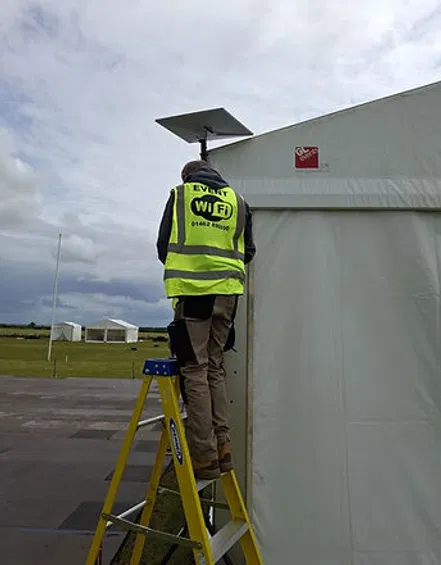
No Signal? No Problem. No Security? Big Problem.
We often talk about how we can bring fast WiFi to the middle of nowhere. It’s a point of pride for us. But speed without security is a disaster waiting to happen.
If you're running a remote event: perhaps a product launch in a rural field: you might think security is less of an issue because "who's going to be there?" But digital threats don't need to be standing in the field with you. They can come through the connection itself if it isn't properly firewalled.
That’s why our satellite solutions, including our specialised Starlink deployments, are built with the same enterprise-grade security as a high-rise office in the City.
The Commsuk Reassurance
We know that "WPA3," "VLAN Segmentation," and "Packet Inspection" sound like a different language. And honestly? You shouldn't have to speak it.
Our job at Commsuk Limited is to be the experts so you don't have to be. When you work with us, you’re not just buying "internet." You’re buying a secure environment. You're buying the knowledge that your attendees' data is safe, your exhibitors' transactions are protected, and your event's reputation is in good hands.
We’ve handled everything from complex urban installations with thousands of users to tiny, high-security VIP gatherings. In every case, the goal is the same: 100% uptime, 100% security.
Summary Checklist: What We Do For You
To keep it simple, here is how we ensure you sleep soundly:
WPA3 Encryption: The latest and greatest in data scrambling.
Device Isolation: Guests can’t "see" or "touch" each other’s devices.
Hidden Admin Networks: Your staff and payment systems are on a separate, invisible lane.
Live Monitoring: We watch for suspicious activity in real-time.
Physical Protection: Hardware is secured against tampering.
Running an event is stressful enough. Let us take the "WiFi security" box and tick it for you: permanently.
If you’re planning your next big show and want to make sure your data is as secure as your venue, get in touch with James and the team. We’ll handle the tech, you handle the standing ovation.
Comments