Rain, Wind and Cold: Why Autumn and Winter Events Are Harder on Your WiFi
Autumn and winter are busy seasons for UK events.
There are agricultural shows, Christmas markets, bonfire nights, winter fairs, outdoor light trails and festivals that run long after the clocks have gone back. They can be brilliant events, but they are also demanding environments for temporary internet.
Rain, wind, cold, mud and low light do not automatically make WiFi stop working. A well-designed wireless network can operate reliably in poor weather. The challenge is that bad weather puts more pressure on every part of the setup: the satellite link, power supply, cabling, equipment, access points and the people using the network.
That matters when your event depends on reliable event WiFi for payments, ticket scanning, staff communications, production systems and live updates.
The weather is not the only problem
It is easy to assume that rain simply weakens a WiFi signal. In reality, short-range WiFi between an access point and a nearby device is usually not the main concern.
The bigger risks are physical:
Water getting into connectors or equipment
Wind moving antennas or temporary structures
Mud and standing water damaging cable runs
Cold affecting batteries and power systems
Poor visibility making setup and checks more difficult
Crowds moving into covered areas when the weather turns
Power interruptions caused by storms or overloaded temporary supplies
In other words, winter weather exposes weak points in an event connectivity plan. If equipment, cabling or power has been treated as an afterthought, the problems tend to appear when the event is busiest.
Rain creates problems at the edges
A good outdoor network uses equipment designed for outdoor conditions. That means weatherproof access points, sealed enclosures and suitable cable protection.
However, even weather-rated hardware can fail if it is installed badly. The vulnerable points are often where cables enter equipment, join together or run back towards a switch.
Water can travel along a cable and into a connector if the run is poorly positioned. Cables left directly on wet ground are also vulnerable to:
Foot traffic
Vehicles and site machinery
Sharp stones and temporary fencing
Pooled water
Movement caused by wind
Accidental damage during event build and breakdown
Our engineers protect those weak points with suitable outdoor-rated cabling, secure routing, raised connections and drip loops where appropriate. Equipment is kept off the ground, cables are managed around pedestrian and vehicle routes, and temporary network points are protected from the conditions around them.
Wind can move more than the marquee
Wind is a particular challenge for outdoor event connectivity because much of the infrastructure is temporary.
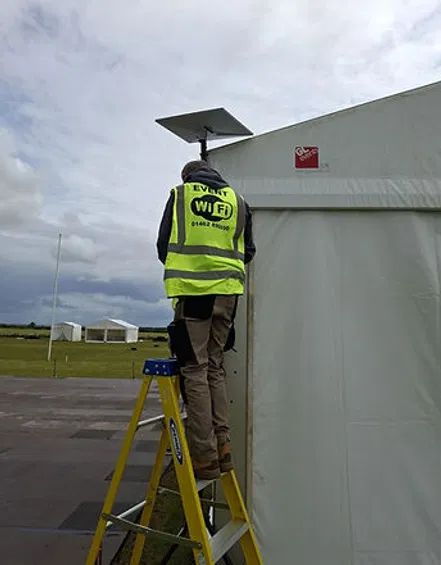
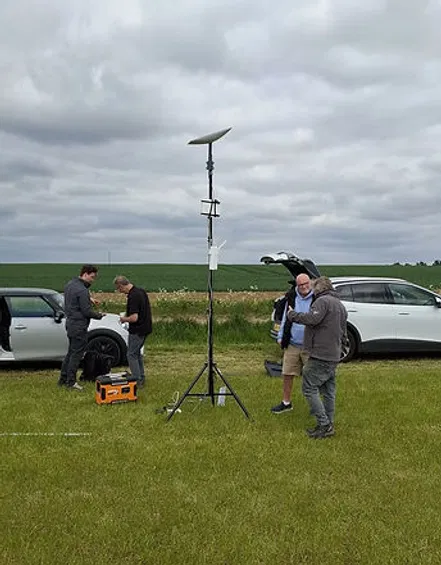
A satellite dish, directional antenna or wireless bridge needs to remain stable and correctly aligned. Strong gusts can move a mast, shake a mounting point or shift a dish just enough to affect performance. Banners, stage dressing and temporary covers can also move into the path of a signal.
That is why mounting matters.
We use suitable stands, ballast and fixing methods for the location. Equipment is positioned with wind exposure in mind, rather than simply placed wherever there happens to be space. Cables are secured so they do not pull against connectors, and critical hardware is checked during the event rather than assumed to be fine once installation is complete.
This is especially important for rural events, where there may be long open distances and very little shelter. A setup that looks secure in calm weather may need additional consideration when the forecast changes.
Cold affects power as well as people
Cold weather can affect batteries, portable power systems and some outdoor networking equipment. It can also make small power problems more noticeable.
Temporary event networks often rely on distributed power: generators, temporary supplies, battery systems and long cable runs. If a supply dips or briefly drops out, switches and access points may restart. That can interrupt staff WiFi, payment devices or production systems at exactly the wrong moment.
We plan power around the whole installation, not just the internet connection. That can include:
Checking the power requirements of every device
Protecting core equipment from damp and condensation
Using suitable backup power for critical network components
Allowing for equipment that may draw more power in cold conditions
Keeping power and data cabling safely separated and protected
Providing spare equipment and replacement cables on site
The aim is simple: a wet or cold day should not become an avoidable connectivity incident.
Mud changes how the site works
Mud is not an RF problem, but it is a serious event infrastructure problem.
It changes where people walk. It changes where vehicles can travel. It makes cable routes harder to maintain and can create standing water around temporary equipment. At an agricultural show or winter market, the route that looked perfectly practical during planning may become a high-traffic area once the ground is wet.
That is why event Wi-Fi planning needs to consider the site as it will be used in real conditions.
We look at where staff, contractors, vehicles and guests are likely to move when the weather is poor. Cable routes are protected and kept clear of access points wherever possible. Equipment cases and network enclosures are positioned so that engineers can reach them safely without creating hazards for visitors.
A reliable network needs to be practical on the ground, not just correct on a diagram.
Low light makes faults harder to spot
An autumn or winter event may be operating in darkness for much of the day. That affects setup, monitoring and fault finding.
Loose cables, pooled water, damaged connectors and shifted equipment are harder to identify in low light. If a problem develops during an evening market or bonfire night, there may be very little time to diagnose it before queues form or payment systems are affected.
We use clear labelling, tidy cable management and practical equipment positioning to make the installation easier to inspect. More importantly, our team remains involved throughout the event. We monitor the connection, check equipment and respond to issues rather than leaving organisers to work out what has happened.
That hands-on support is particularly valuable when the weather changes quickly.
Rain can change the crowd, and the network
One of the less obvious effects of bad weather is that it changes how guests use the site.
When rain arrives, people move under marquees, into covered walkways or towards indoor areas. At a Christmas market, visitors may cluster around heated spaces, food stalls and sheltered entrances. At an agricultural show, staff and exhibitors may spend more time inside trade stands.
That creates sudden demand in places that were not necessarily the busiest during dry-weather planning.
At the same time, staff may be relying more heavily on connectivity. They may need to process payments, contact security, coordinate deliveries, update schedules or communicate with production teams.
A resilient network should support more than guest access. It should prioritise the systems that keep the event operating:
Staff WiFi for organisers, stewards and event teams
Production WiFi for show control, staging and technical crews
Payment and point-of-sale devices
Ticketing and access control
Exhibitor and supplier systems
Operational communications and monitoring
The network needs to remain useful when the event does not go exactly as planned.
Redundant links provide breathing room
No connectivity method is completely immune to severe weather or a site-wide power issue. That is why resilient event connectivity is built with more than one route wherever the event requires it.
Depending on the location and requirements, that may include satellite internet supported by an additional connection, cellular failover or other redundant links. The exact solution depends on the site, capacity and critical applications.
Redundancy is not about making the setup unnecessarily complicated. It is about avoiding a single point of failure. If one link is affected, the event still has a way to process payments, communicate with staff and keep essential systems online.
We can plan, install and manage the connection from the initial preparation through to monitoring and complete teardown. Our event WiFi service is designed for temporary sites, including locations where traditional broadband is unavailable or unsuitable.
Monitoring matters more in winter
A weatherproof installation is only part of the solution. Conditions can change throughout the day, so the network needs to be watched while the event is live.
On-site monitoring helps identify:
Drops in backhaul performance
Equipment going offline
Unusual client demand in a particular area
Power or temperature warnings
Damage or movement around cable routes
Failover links being used
Early action is much easier than waiting for a complete outage. A cable can be rerouted, a dish can be checked, an access point can be replaced or extra capacity can be directed to a busy zone before a small issue becomes a visible problem.
A winter-ready event network starts before the forecast
The best time to think about rain and wind is before the event build begins.
We plan around the location, the expected use of the network and the practical realities of the site. That includes equipment selection, mounting, cabling, grounding, power, backup connectivity and how the network will be monitored once guests arrive.
For organisers, the benefit is straightforward: you do not need to spend the event watching the weather and wondering whether the WiFi will hold.
From small winter pop-ups to large agricultural shows and Christmas markets, Commsuk handles the connectivity details from planning and installation to live support and teardown. Talk to our team about making your next outdoor event ready for whatever the UK weather brings.
For additional background, see our guide to why Commsuk uses satellite internet for event WiFi.
Comments