The Site Survey: Why We Scout Your Venue Before the First Cable is Run
If you’ve ever organised a large-scale event, you know the "Installation Day" jitters. It’s that moment when a fleet of vans rolls onto the grass, and suddenly, a thousand moving parts need to click into place. Among those parts: and increasingly the most critical one: is the WiFi.
In the world of event production, there is a dangerous temptation: the "plug and play" myth. It’s the idea that you can simply turn up at a field or a venue, point a satellite dish at the sky, and magically provide high-speed internet to five thousand people.
At Commsuk Limited, we’ve been around the block (and the festival field) enough to know that "guessing" is the quickest way to a network crash. That’s why our process doesn’t start with a cable; it starts with a site survey.
In this post, we’re pulling back the curtain on why we scout your venue weeks: or even months: before the event begins.
The "Guessing" Game vs. Reality
When you’re at home, your WiFi router lives in a predictable environment. You know where the walls are, where the sofa is, and roughly how many people are using it. An event is the exact opposite. It is a living, breathing, evolving ecosystem of interference.
A site survey is our way of "measuring twice and cutting once." Without it, you’re essentially flying blind. You might assume that a single access point can cover the main stage, only to find out on show day that the massive LED screen you’ve installed is acting as a giant wall of electromagnetic interference.
By scouting the venue early, we transform "we think this will work" into "we know this will work."
1. Identifying Physical Obstacles: Nature’s Signal Blockers
Event organisers often think in terms of lines of sight for the audience, but we think in terms of lines of sight for data. WiFi signals are essentially high-frequency radio waves, and they are surprisingly sensitive.
The Tree Trouble
Trees are beautiful for a festival backdrop, but they are a nightmare for connectivity. Leaves contain water, and water is excellent at absorbing 2.4GHz and 5GHz radio frequencies. A site survey allows us to identify "foliage fade." If we’re relying on a point-to-point wireless link across a field, we need to know if that oak tree in the middle is going to kill the signal the moment the wind blows.
The Metal Marquee Trap
Modern event marquees often use heavy-duty metal frames and sometimes even foil-lined insulation. To a WiFi signal, a large metal structure is essentially a Faraday Cage. During our survey, we map out where these structures will be. We plan for internal access points and external "repeaters" to ensure the signal flows around and through these obstacles rather than bouncing off them.
Hills and Topography
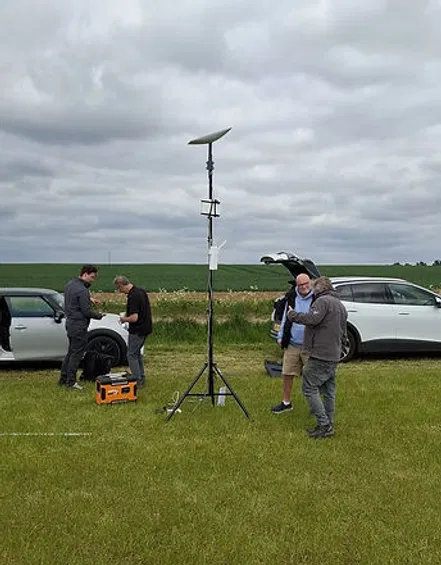
If you’re running a rural agricultural show, the "middle of nowhere" often comes with rolling hills. If our satellite uplink is in the production office at the bottom of a hill, and the ticketing gate is on the other side of the ridge, we need to plan for relay stations. We’ve written before about the challenges of bringing fiber-fast WiFi to the middle of nowhere, and the site survey is the secret sauce that makes it happen.
2. Mapping the Invisible: Radio Frequency (RF) Interference
The biggest threat to your event WiFi isn't something you can see. It's the "noise" in the air.
During a site survey, we use spectrum analysers to listen to the environment. Even in a remote field, there can be "invisible" interference:
Competing Networks: Are there nearby businesses or venues with their own WiFi?
Emergency Services: Are we near a flight path or a police frequency?
AV Gear: High-end wireless microphones and lighting rigs often occupy the same frequencies as WiFi.
If we know that the 2.4GHz band is absolutely flooded with noise from a neighbouring site, we can design your network to prioritise the 5GHz or 6GHz bands, ensuring your exhibitors have successful shows without their card machines dropping out.
3. The Human Factor: Bodies as Obstacles
Here’s a fun fact: humans are roughly 70% water. As we mentioned earlier, water absorbs WiFi signals.
A venue that tests perfectly when it’s empty will behave completely differently when it’s packed with three thousand people. Our site survey doesn't just look at the empty field; it looks at the event plan. We ask where the crowds will gather.
Is there a queue for the bars?
Where is the main stage "mosh pit"?
Where are the food vendors located?
By understanding the density of people, we can place our access points high enough (on poles or trussing) to "beam" the signal down onto the crowd, rather than trying to push it through a sea of bodies.
4. Power and Infrastructure Logistics
"Where is the power?" is the most common question asked during a site survey.
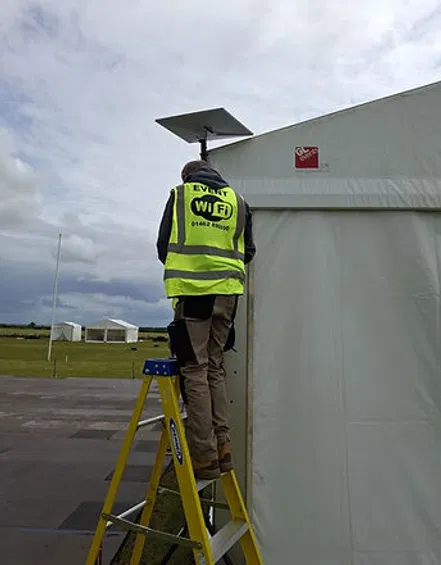
WiFi access points and satellite dishes need juice. While we can run long-distance Power-over-Ethernet (PoE) cables, there are limits. During the scout, we identify:
Where the generators will be located.
Whether we need to bring our own battery backups or solar solutions.
Safe cable runs that won't be tripped over by attendees or run over by site vehicles.
Getting this right in the planning stage means that on installation day, our team isn't hunting for a socket: they’re already plugging in.
5. Tailoring the Solution: Satellite, 5G, or Hybrid?
Every event is different. A pop-up product launch in Central London has different needs than a three-day festival in the Cotswolds.
Our site survey determines the "Backhaul": how we actually get the internet into the site.
Satellite: Ideal for remote areas where there’s zero infrastructure.
4G/5G Bonding: Great for urban areas where we can combine multiple cellular signals for extra reliability.
Hybrid: Sometimes we use both to ensure that if one fails, the other takes over instantly.
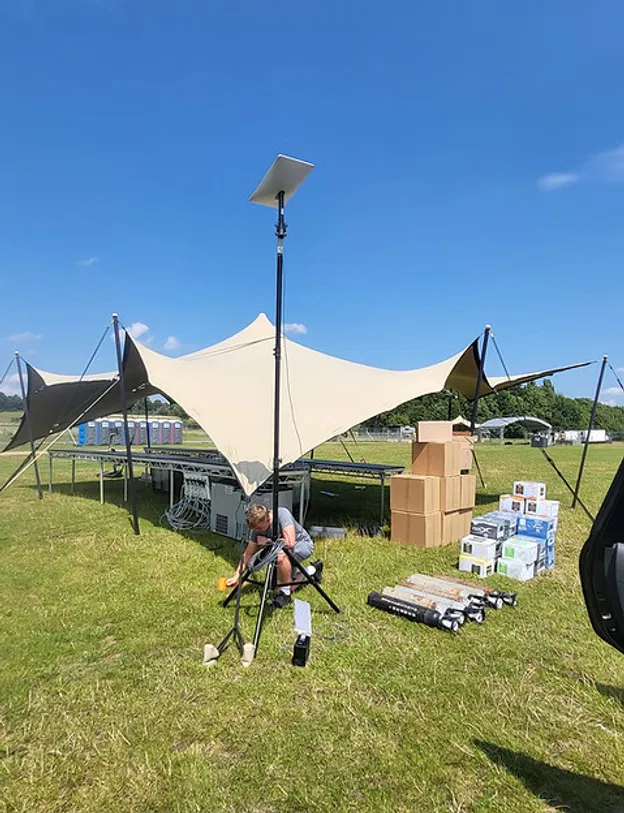
By checking the local cellular strength and the satellite "view of the sky" during the survey, we ensure we bring the right kit. There’s nothing worse than arriving with a 5G rig only to find the venue is in a complete signal dead zone.
Why Commsuk? Because We Hate Surprises
In the event world, "surprises" are rarely a good thing. A surprise is a cable that won't reach. A surprise is a signal that won't penetrate a catering van. A surprise is a card machine that stops working right as the lunch rush starts.
We do the site survey because we want your installation day to be boring. We want it to be a matter of routine.
When we scout your venue, we aren't just looking at the ground; we’re mapping out the "invisible" plan. We’re identifying the backup routes and the fallback positions. We’re making sure that when your attendees want to share their experience on social media, the network is ready and waiting for them.
The Result: Seamless Connectivity
The ultimate goal of all this scouting, testing, and mapping is simple: a reliable connection that "just works." When the site survey is done correctly, the technology fades into the background, and the event takes centre stage.
From the ticketing gates at the entrance to the live-streamed keynote on stage, everything depends on that invisible web of connectivity. At Commsuk, we make sure that web is rock-solid.
Ready to plan your next event?
Don’t leave your connectivity to chance. Let us handle the scouting, the surveys, and the setup so you can focus on running a great show.
Get in touch with Commsuk today to book your site survey.
Comments