Why Christmas Markets Need Satellite WiFi (and Why Your Card Payments Depend on It)
Christmas markets are no longer cash-only events.
Today, visitors expect to pay by contactless card, phone or smartwatch. Vendors rely on cloud-based tills and payment terminals. Organisers use digital ticketing, cashless systems, staff messaging and online reporting to keep the market running smoothly.
That makes reliable connectivity essential.
A payment terminal may be small, but it depends on a stable connection every time a customer taps their card. If that connection slows down or disappears during the busiest evening of the season, queues build, sales are lost and the market experience suffers.
For temporary Christmas markets in historic squares, town centres, parks and outdoor sites, satellite WiFi can provide the dependable connection that payment systems need.
Christmas markets depend on connected payments
Most festive markets are built around quick, convenient transactions. Customers want to collect a hot chocolate, buy a handmade gift or order food without searching for cash.
Vendors need to process those transactions quickly, especially during the evening rush.
A modern Christmas market may use:
Contactless card readers
Mobile wallets such as Apple Pay and Google Pay
Cloud-based tills and EPOS systems
Cashless wristbands or prepaid accounts
Digital receipts
Online stock and sales reporting
QR-code ordering or collection systems
All of these services need connectivity. A card reader typically sends payment information securely to the payment provider, waits for authorisation and confirms the transaction. If the connection is weak, the payment can take too long or fail completely.
That is why payment connectivity should be treated as part of your core event infrastructure, not as an optional extra.

Why public WiFi and mobile networks can struggle
A town centre may appear to have excellent 4G or 5G coverage on an ordinary day. That does not necessarily mean it can support a busy Christmas market.
Festive events create a sudden concentration of people and devices. Visitors are using their phones for maps, messaging, social media, mobile ordering and digital payments. Vendors are running card terminals and tills. Organisers may be using tablets, radios, scanners and laptops.
Thousands of devices can be competing for the same local network capacity.
Even if each vendor’s card reader normally works well on mobile data, performance may change dramatically when the market opens. A connection that was fast during the morning setup could become slow or unreliable at 7pm when the streets are full.
Historic squares and city-centre locations can also create practical challenges:
Temporary stalls may be spread across several streets
Buildings can obstruct or weaken signals
Fibre may not be available at every trading location
Public WiFi may not be designed for business-critical transactions
Temporary sites may have no permanent network infrastructure
Nearby events, shops and visitors may all be using the same mobile capacity
This is the difference between having a signal and having dependable event connectivity.
For a Christmas market organiser, relying entirely on whatever network happens to be available locally can leave an important part of the event to chance.
How satellite WiFi supports payment systems
Satellite internet gives your market an independent connection to the wider internet. Rather than relying solely on a local fibre line or crowded mobile mast, a satellite dish connects to satellites overhead and provides the primary internet feed for the event network.
That connection can then be distributed securely to:
Vendor card readers
EPOS terminals and tills
Cashless payment systems
Staff devices
Organiser offices
Ticketing and entry points
Production and event-control teams
The important point is that satellite WiFi is not simply about giving visitors internet access. It can be designed around the market’s operational priorities.
Payment traffic can be separated from guest WiFi. Vendor systems can have their own protected network. Staff devices can be kept apart from public browsing. This helps ensure that a busy guest network does not interfere with the systems responsible for taking payments.
For markets in temporary or remote locations, satellite connectivity also avoids the need to wait for a permanent broadband installation. With the right planning, a professional team can bring the connection to the site, install the equipment and have the network ready for trading.
Backup links provide extra peace of mind
No connection should be treated as completely risk-free, particularly when an event depends on it for revenue.
That is why resilient event WiFi planning should include a backup strategy.
A managed Christmas market network may use satellite as the primary connection, with a secondary mobile or other available link ready to take over if required. If the main connection experiences a problem, traffic can be redirected to the backup route.
This approach helps protect the essentials:
Card payments continue processing
Vendor tills remain connected
Staff can communicate
Organisers can monitor the event
Entry and ticketing systems stay available
Customers are less likely to face failed transactions
A backup link cannot compensate for every possible issue, and individual payment terminals may have their own offline rules. However, independent connectivity and automatic failover can significantly reduce the risk of a market-wide payment outage at the worst possible moment.
It is a much stronger approach than hoping a public network will cope when the crowds arrive.
Connectivity supports more than card readers
Payments may be the most visible reason to plan your network properly, but Christmas markets rely on connectivity in many other ways.
Staff communications
Market teams need to stay in contact across stalls, entrances, bars, catering areas and production zones. Reliable connectivity supports messaging, operational updates and coordination between stewards, security and organisers.
Music and festive lighting
Many markets use network-connected lighting controllers, audio systems and production equipment. A dependable connection can help technical teams monitor and manage these systems throughout the event.
Vendor tills and reporting
Vendors may need access to cloud-based tills, stock information, online ordering platforms and end-of-day sales reports. Losing access can slow down service and make reconciliation more difficult.
Organiser operations
Event managers may use online dashboards to monitor footfall, payments, staffing, incidents and customer information. The same network can support printers, tablets, laptops and control-room equipment.
The goal is not to provide the same level of access to every device. The goal is to give each part of the market the right connection for its role.
Quick setup for temporary market sites
Christmas markets often have a short installation window. Stalls may only arrive a day or two before opening, while roads, public spaces and trading areas need to be cleared quickly after the final event.
That makes speed and planning especially important.
A professional event connectivity service should cover the complete process:
Site survey – reviewing the layout, structures, power availability and likely sources of interference.
Network design – deciding where connectivity is needed and separating payment, staff, production and guest access.
Satellite installation – positioning the dish with a suitable view of the sky and connecting it to the network equipment.
Access point deployment – placing WiFi equipment where vendors and operational teams need reliable coverage.
Payment testing – checking card readers, tills and cashless systems before the market opens.
Live monitoring – watching the network during trading hours and responding quickly if an issue appears.
Teardown – removing the equipment cleanly when the market closes.
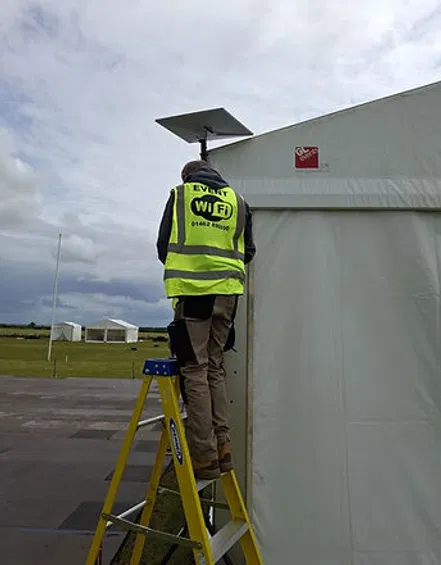
At Commsuk, we provide fully managed event WiFi, from pre-event planning and site surveys through to installation, monitoring and teardown. That means organisers do not have to troubleshoot card readers or chase connectivity problems while managing crowds, traders, safety and the wider event.
Plan before the lights go on
The best time to discover a payment connectivity problem is during testing, not during the busiest trading period of the market.
Include connectivity in your event planning from the beginning. Share your site map, vendor layout, payment requirements and expected visitor numbers with your provider. Identify which systems are critical and decide how they should be protected.
This is the practical side of event Wi-Fi planning. It is about understanding what the market needs before equipment is installed, rather than adding WiFi as an afterthought.
You can read more about Commsuk’s use of satellite technology in Why Commsuk Uses Starlink Satellites for Event WiFi. For a wider look at why managed support matters, see Set It and Forget It: Why Your Event WiFi Needs a Human Touch.

Keep the market moving
A Christmas market should be remembered for its lights, food, music and atmosphere: not for failed card payments and long queues.
Satellite-backed event WiFi gives organisers a reliable way to connect payment systems, vendor tills, staff communications and production technology, even when a temporary site has no fibre and local mobile networks are under pressure.
With the right site survey, network design, backup connection and on-site support, your market can stay connected from the first customer of the morning to the final sale of the evening.
If you are planning a Christmas market, contact Commsuk to discuss a dependable connectivity plan for your site. We will help you build the network, monitor it during the event and take care of the technical details: so you can focus on delivering a festive experience that works for visitors and vendors alike.
Comments