Agricultural Shows and Rural Events: Bringing Reliable WiFi to a Field With No Infrastructure
Agricultural shows are brilliant events. They bring people together, showcase local businesses, support rural communities and create a full day of activity across a large open site.
They are also some of the hardest events to connect.
A showground may have no fibre, no venue network and no dependable mobile signal. The site can stretch across fields, car parks, marquees, livestock rings and exhibition areas. Then thousands of visitors arrive at once, all using their phones and competing for the same nearby mobile mast.
That is a difficult environment for event WiFi. But with the right planning, it does not need to be a difficult problem.
Why rural events are a connectivity challenge
Most permanent venues have at least some infrastructure to work with. There may be a fixed broadband connection, a server room, wired network points or an in-house IT team.
A field usually has none of those things.
The nearest fibre connection may be too far away. The mobile signal may be weak or inconsistent. Even when the signal looks fine during an early site visit, it can slow down dramatically once the gates open and hundreds or thousands of people begin using it.
There is also the size and shape of the site to consider.
An agricultural show might include:
Several public entrances and ticketing points
Trade stands spread across multiple fields
Food and drink outlets
Livestock rings and auction areas
Marquees and metal-clad barns
Press and media areas
Stewards’ offices and production compounds
Large car parks and camping areas
A single router in one office cannot cover all of that. Nor can you assume that a phone hotspot will keep every important system running.
Good event WiFi planning starts by understanding the whole site, not just the main office.
What depends on connectivity at an agricultural show?
It is easy to think of WiFi as something visitors use to browse or share photos. At a modern agricultural show, the network is involved in much more than that.
Card payments
Trade stands, food outlets, bars and catering vans increasingly rely on card machines. If a terminal cannot connect, a sale can be delayed or lost.
That is frustrating for the trader and reflects badly on the event. A reliable network gives exhibitors a much better chance of taking payments smoothly throughout the day.
Ticketing and gate scanning
Online ticket sales and digital entry systems have made admission faster and easier. But scanners still need a dependable connection to check tickets, update records and keep queues moving.
If connectivity fails at the gate, small delays can quickly become long queues.
Livestock auctions and judging systems
Agricultural shows often have specialist systems for livestock entries, judging, results and auctions. These may need to connect between the ring, the administration team and online platforms.
The network needs to work where the activity takes place, not just where the main office happens to be.
Steward and security communications
Your team may be using messaging apps, push-to-talk systems, cloud-based tools or connected radios to coordinate the event.
They need to know about a blocked entrance, a medical issue, a lost child or a change to the programme quickly. Reliable staff wifi and event connectivity help keep those conversations moving.
Of course, some radio systems work independently of the internet. But the wider communication systems around them may still depend on it.
Exhibitor paperwork and entries
Exhibitors may need to upload documents, process registrations, check stock systems, use QR codes or access cloud-based records. Giving them dependable connectivity makes the event easier to run and more professional to attend.
Press, social media and live updates
The event may be covered by local media, trade publications and your own social channels. A good connection allows teams to send photographs, publish updates and share results from the field while the show is still happening.
That visibility can help build interest in the next event.
Satellite internet solves the “no infrastructure” problem
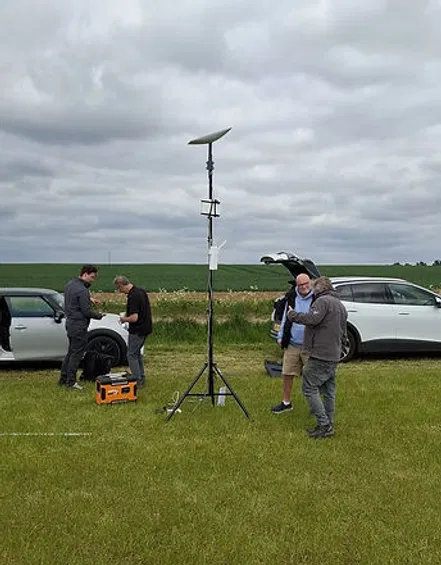
When there is no fixed line and mobile coverage cannot be trusted, satellite internet provides a practical way to bring a connection to the site.
The equipment arrives with us. It does not depend on the showground having a broadband service already installed. With a suitable view of the sky and the right positioning, the satellite link can provide the main internet connection for the event.
Modern satellite services are fast enough to support the everyday systems an agricultural show relies on, including ticketing, card payments, cloud software, staff communications and controlled guest access.
You can read more about why Commsuk uses Starlink satellites for event WiFi.
The important point is that you do not have to source, install or manage the satellite equipment yourself.
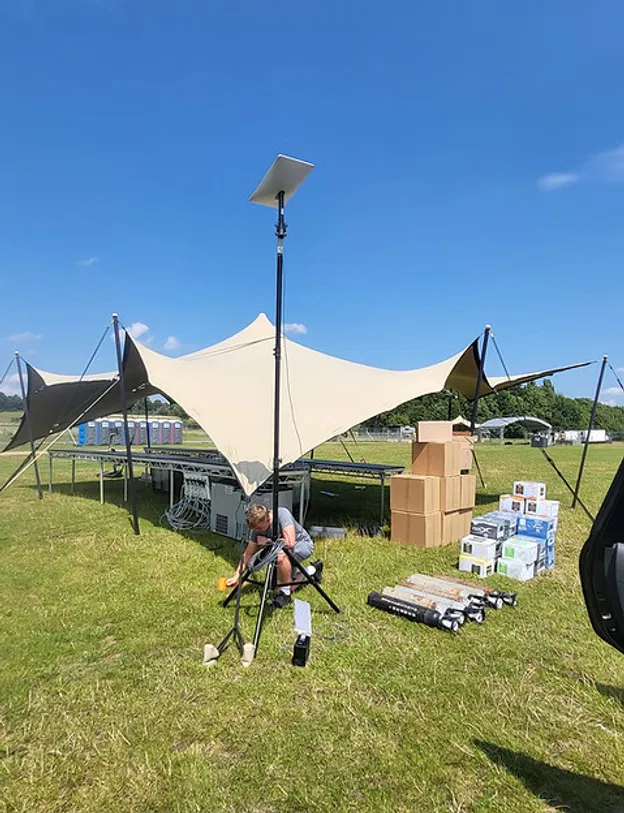
We handle the delivery, setup and testing. The aim is to have the connection live before the gates open, with time to check the network and make any adjustments.
Connecting a spread-out showground
Getting internet to the site is only the first part. The next job is getting the right level of coverage to the people and systems that need it.
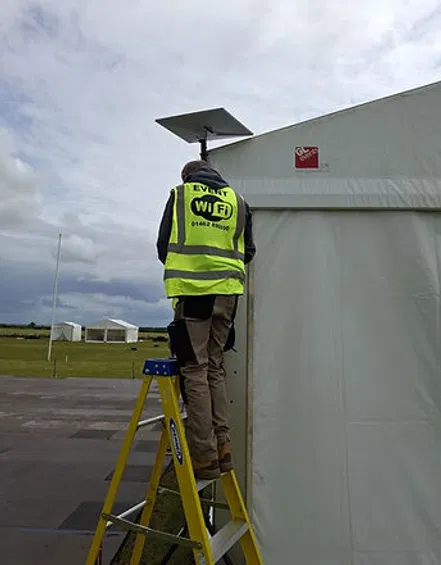
Access points can be positioned around the showground, rather than leaving one router to struggle from a distant office. That might mean placing equipment near:
Main entrances and ticketing gates
Trade stand areas
Food and drink zones
Livestock rings
Auction or judging areas
Press and production offices
Staff compounds
Main marquees and barns
The layout needs to reflect how the event will actually be used.
Large crowds can absorb and weaken wireless signals. Trees, hills, vehicles and temporary structures can also affect coverage. Metal-clad barns and some marquees may create particularly difficult conditions, with the signal struggling to pass through the structure.
That is why access points may need to be installed inside buildings, under marquees or in carefully chosen positions around them. A proper survey helps identify these areas before installation day.
The result should be consistent coverage where it matters, without dead zones that leave a card machine, scanner or staff member disconnected at the worst possible time.
Resilience when the show cannot stop
No event organiser wants their whole operation depending on one connection.
A resilient setup uses built-in backups so that if one link becomes unavailable, another can take over. Depending on the location and requirements, this may include a combination of satellite and mobile connections across different networks.
This is especially useful for critical services such as ticketing, payments and staff communications.
It also gives the event team confidence that a problem with one part of the setup does not automatically bring everything to a halt.
The network can be separated into different services too. For example:
Staff wifi for organisers, stewards and operations
Exhibitor wifi for traders and suppliers
Public WiFi for visitors, if required
A protected network for ticketing, payments and other critical systems
This keeps important traffic separate and helps ensure that public browsing does not interfere with the systems keeping the show running.
Practical event Wi-Fi planning advice
You do not need to be an IT expert to help plan a reliable connection. A few early details make a significant difference.
Share the site plan early
Send over the latest site map, even if it is still being updated. Include entrances, marquees, livestock areas, trade stand zones, production offices, car parks and any buildings being used.
The earlier we understand the layout, the more time we have to plan equipment positions and safe cable routes.
Highlight heavy-use areas
Tell us where the most important activity will happen.
That could be the main gate, the food court, a busy auction ring, a press office or a row of high-volume exhibitors. These areas may need additional capacity or stronger coverage.
Decide who needs which network
Make it clear which groups need access to the network:
Event staff
Security and stewards
Exhibitors and traders
Production teams
Press and media
VIPs
General visitors
Keeping these groups separate makes the connection easier to manage and gives priority to essential services.
Test the systems before show day
If you are using new ticket scanners, payment terminals or cloud software, test them on the planned network before the event.
It is much easier to find a compatibility issue during setup than when there is a queue at the gate.
Let us handle the connectivity
An agricultural show should be remembered for the animals, exhibitors, competitions and atmosphere, not for payment failures or staff struggling to communicate.
At Commsuk, we manage the complete process. We survey the site, assess the requirements, bring the satellite and network equipment, install it in the right locations, monitor the connection throughout the event and remove everything afterwards.
Our rural event connectivity service is designed for locations with little or no existing infrastructure.
So whether you are organising a small country show, a large agricultural exhibition or a busy rural festival, you do not have to leave connectivity to chance.
Talk to Commsuk about your next event and let us take WiFi off your list of things to worry about on show day.
Comments